
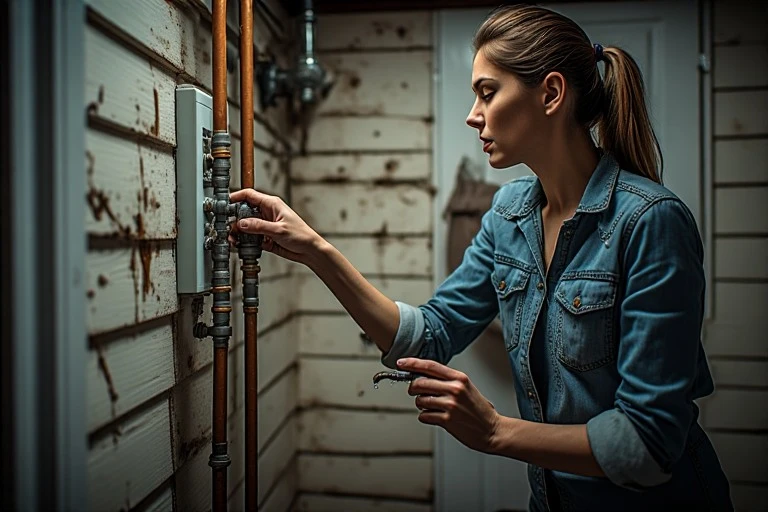
A pipe bursts at 2am. A toilet overflows and won’t stop. A washing machine hose pops loose. In any of these moments, the difference between a minor mess and a $10,000 water damage claim is often less than 60 seconds — and knowing exactly where to go and what to turn.
Why this matters right now
Water damage is the second most common home insurance claim in the US. Most of that damage happens not because of the initial failure — but because nobody in the home knew how to stop the flow fast enough.
The main shutoff — your single most important valve
Every home has one master water shutoff valve that cuts water supply to the entire house. Turning this off stops all water flow immediately, no matter which pipe, fixture, or appliance is failing.
The problem? Most homeowners have never located it before the moment they desperately need it.
- 1Find it now, before any emergency. In most homes, the main shutoff is located where the water supply line enters the house — typically near the front foundation wall in a basement, crawl space, utility room, or garage. In warmer climates, it may be outside near the street.
- 2Know your valve type. There are two kinds: a gate valve (round wheel handle — turn clockwise to close, takes several rotations) and a ball valve (lever handle — turn 90° perpendicular to the pipe to close). Ball valves are faster and more reliable.
- 3Test it today. Shutoff valves that haven’t been used in years can seize. Turn yours off and back on at least once a year so it works when you actually need it.
- 4Also locate the street-side shutoff. Near your water meter (usually at the street or sidewalk), there’s a municipal shutoff. This requires a water meter key tool to operate and is the last resort if your internal valve fails.
Quick tip
Right now, go find your main shutoff and write its location on a sticky note inside your breaker box. It takes 30 seconds and could save you thousands.
Fixture-level shutoffs — targeted and faster
For most plumbing emergencies, you don’t need to cut water to the whole house. Every fixture has its own individual shutoff valve — and using it means the rest of your home keeps running normally while you deal with the problem.
Toilet
Oval valve on the wall behind/below the tank. Turn clockwise to close.
Sink
Two valves under the cabinet — one hot, one cold. Turn both clockwise.
Washing machine
Two valves behind the unit on the wall. Hot and cold — turn both off.
Water heater
Cold supply valve on top of the tank. Turn clockwise. Also shut off the gas or breaker.
Shower / bath
Access panel behind the wall or in the adjacent room. May need a screwdriver.
Refrigerator
Small saddle valve behind or under the unit feeding the ice maker line.
The golden rule: if a fixture is leaking or malfunctioning, start at the fixture’s own valve — not the main shutoff. It’s faster, and it keeps the rest of your plumbing running.
Why every family member needs to know this
Here’s a scenario that plays out in homes every day: a pipe starts spraying under the kitchen sink at 8am. The person who knows where the shutoff is — isn’t home. The one who is home has no idea where to look, can’t remember if it’s even been pointed out before, and spends 12 panicked minutes on the phone while the water keeps running.
Shutoff knowledge is a household skill, like knowing how to dial 911. It belongs to everyone in the home — adults, teenagers, even younger kids with a simple “turn this red wheel if water is everywhere” instruction.
Make it a family moment: do a 10-minute walkthrough of your home’s shutoffs together. Point out the main valve, walk through each bathroom, show them what to look for under each sink. That’s it. One walkthrough could prevent one disaster.
The 60-second habit that protects your home
You don’t need a plumbing background to handle a water emergency. You just need to know where two things are: your fixture shutoff and your main shutoff. Everything else — the repair, the insurance claim, the plumber call — can wait 10 minutes. The water cannot.
Take the walkthrough today. Show your family. Fill in that reference card. It’s the single lowest-effort, highest-impact thing you can do for your home’s safety right now.